About
Professional Background & Expertise

Mark Darland
AWS Solutions Architect
An accomplished Information Technology professional with over 23 years of hands-on experience in enterprise IT infrastructure. Throughout my career, I have developed deep expertise in Linux and Windows Server administration, working across diverse environments from small businesses to large-scale enterprise deployments.
My technical foundation spans system administration, network infrastructure, cloud architecture, and cybersecurity. I have contributed to numerous successful projects involving server migrations, infrastructure modernization, security implementations, and cloud adoption initiatives.
Professional Certifications
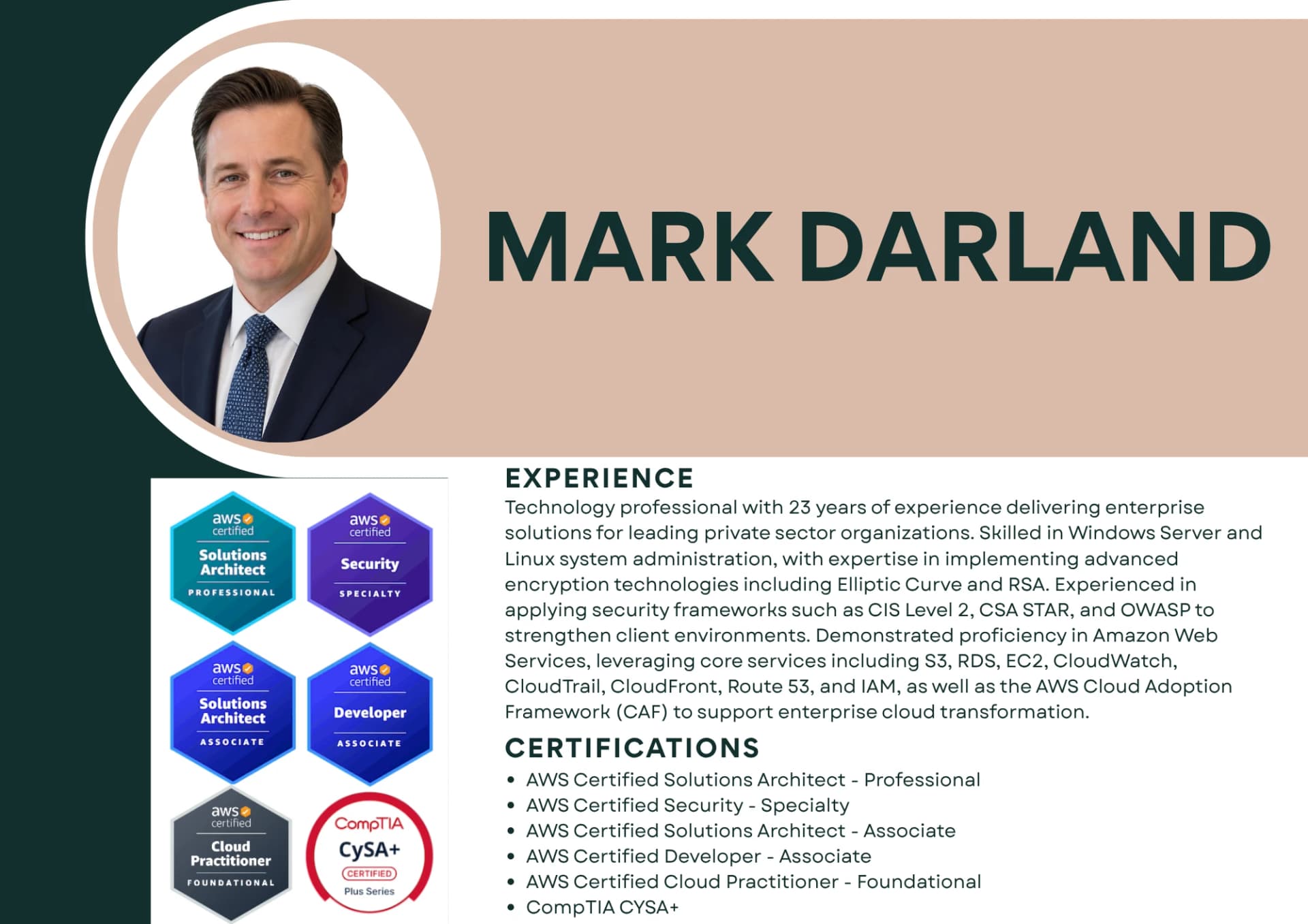
AWS Certifications
- •AWS Certified Solutions Architect - Professional
- •AWS Certified Security - Specialty
- •AWS Certified Solutions Architect - Associate
- •AWS Certified Developer - Associate
- •AWS Certified Cloud Practitioner - Foundational
Industry Certifications
- •CompTIA CYSA+
Core Competencies

Linux Server Administration
Extensive experience with enterprise Linux distributions including Red Hat Enterprise Linux 9, CentOS, Ubuntu Server, and SUSE. Proficient in system configuration, performance tuning, automation with shell scripting and Ansible, and managing critical production environments. Skilled in implementing security hardening aligned with CIS Level 2, OWASP, and CSA STAR standards.

Windows Server Administration
Comprehensive knowledge of Windows Server environments (2022/2019/2016), Active Directory management, Group Policy implementation, PowerShell automation, and enterprise application deployment. Experience with IIS 7.5/8.0/10.0, Tomcat 9.0, Liferay 6.2, and Apache Web Server.

Cloud Infrastructure & AWS
Advanced proficiency in AWS services including S3, RDS, EC2, CloudWatch, CloudTrail, CloudFront, Route 53, and IAM. Skilled in cloud migration strategies, infrastructure as code, implementing secure network architectures with DNSSEC, and delivering optimized content through Elastic Load Balancing and global Content Delivery Networks. Experience with AWS GovCloud and Nutanix.

Network & Security
Strong foundation in network administration, firewall configuration, VPN implementation, and security best practices. Expertise in implementing security frameworks including DISA STIG, CIS Level 2, NIST, OWASP for Tomcat and IIS, and CSA STAR. Proficient in encryption technologies including Elliptic Curve and RSA. Experience with unified threat management through Elasticsearch and Syslog-NG integrations.

Database Administration
Skilled in database migrations across Oracle (9i/10g/11g/12c), MS SQL Server (2017/2014), MySQL 8, and MariaDB 10.4. Proficient in SQL performance tuning, PL/SQL, XML, and application development in Java and .NET. Experience with integrated development environments including Java Eclipse and Microsoft Visual Studio 2017.

Enterprise Hardware
Hands-on experience with enterprise-grade hardware including HPE servers, Cisco VCenter, IBM Blade Center, Cisco Catalyst switches, and Palo Alto and Juniper firewalls. Proficient in hardware configuration, maintenance, and optimization for high-availability environments.
Technical Expertise

Software Security & Supply Chain Risk Management
Countering security vulnerabilities in software libraries, improving security in network gateway devices, and mitigating software supply chain attacks represent three interconnected pillars of modern cybersecurity architecture. As the software ecosystem increasingly depends on open-source components, third-party frameworks, and globally distributed codebases, adversaries exploit vulnerabilities buried deep within software dependencies or communication gateways to infiltrate trusted environments.
Mitigating such risks demands a multidimensional defense strategy that integrates proactive vulnerability management, zero-trust architectures, runtime verification, and secure development lifecycles governed by established frameworks such as NIST 800-161, ISO 27036, and the Open Web Application Security Project (OWASP) Software Component Verification Standard (SCVS).
Software libraries, often maintained by decentralized communities, have become prime vectors for exploitation through dependency confusion, malicious package injection, or outdated versions containing unpatched flaws. Effective countermeasures start with a comprehensive Software Bill of Materials (SBOM), which enumerates all components and dependencies in a given application, enabling visibility into potential weaknesses and ensuring traceability during incident response.
Automated scanning tools such as OWASP Dependency-Check, Snyk, or GitHub Advanced Security leverage Common Vulnerabilities and Exposures (CVE) databases to detect known issues in third-party modules, while dynamic and static analysis tools identify exploitable code paths during the development pipeline. To strengthen resilience, organizations must enforce dependency version pinning, restrict external package repositories, and use digital code signing with verified cryptographic keys to authenticate package integrity before integration.
Professional Approach
Throughout my career, I have maintained a commitment to continuous learning and staying current with evolving technologies. I approach challenges methodically, focusing on understanding business requirements and delivering reliable, maintainable solutions.
My experience spans various industries and organizational sizes, providing perspective on different operational models and technical requirements. I value clear communication, thorough documentation, and collaborative problem-solving.
I remain dedicated to infrastructure reliability, security best practices, and operational excellence. My goal is to contribute technical expertise that supports organizational objectives and enables business success.
Connect
Find me on various professional and social platforms using the links in the footer below.